

Esta publicación analiza la importancia de las puertas rápidas autorreparables en el sector industrial. Con la creciente relevancia de estas puertas de alto rendimiento, estas se autorreparan y se reajustan automáticamente para satisfacer la necesidad de apertura rápida. Estas puertas son la solución perfecta para ahorrar tiempo y dinero. La tecnología avanzada de las puertas rápidas autorreparables las convierte en la opción ideal para un funcionamiento eficiente en diversos entornos. Estas puertas industriales automáticas se reparan a sí mismas, y explicaré por qué son imprescindibles para todo edificio industrial moderno. Las puertas autorreparables ahorrarán dinero en mantenimiento y mejorarán la eficiencia operativa. ¿Son una buena inversión? Las puertas rápidas autorreparables le dirán por qué y cómo. Comencemos.
Introducción a las Puertas Rápidas Autorreparables

Puertas rápidas autorreparables han sido diseñadas para abordar todos los problemas de mantenimiento y tiempo de inactividad. No existe otra solución como estas puertas en el mercado actual. Si la puerta es golpeada y se sale de sus rieles, se reacomodará automáticamente y continuará su operación. Las cortinas son flexibles, permitiendo que la puerta se realinee automáticamente sin necesidad de intervención humana. Este proceso asegura la continuidad operativa de la puerta, sin necesidad de mantenimiento adicional ni acumulación de costos a lo largo de los años.
Las puertas autorreparables actuales se mantienen a la vanguardia tecnológica con prototipado de alta gama, como la integración de sensores y motores de velocidad variable, permitiendo que la puerta logre alta eficiencia energética y un rendimiento operativo optimizado. La puerta está construida para entornos de alto tráfico y trabajo extremo, incluyendo almacenes, edificios de fabricación y cámaras frigoríficas. La alta eficiencia energética y la facilidad de mantenimiento convierten a estas puertas en una elección obvia para instalaciones que necesitan optimizar la eficiencia y altos niveles de productividad.
Definición y Concepto Fundamental
Existen puertas industriales especializadas llamadas conjuntos de puertas rápidas autorreparables, diseñadas para autorrepararse. Algunas puertas automáticas están diseñadas para operar de manera suave y sin interrupciones incluso después de sufrir impactos. Las puertas autorreparables cuentan con características automáticas especializadas que permiten realinear el conjunto de la puerta sin costo alguno. Estas puertas autorreparables están hechas para repararse a sí mismas, lo que les permite operar en entornos de alto volumen y exigencia. Esto las convierte en la puerta autorreparable ideal para alto volumen.
Características Clave y Datos de las Puertas Rápidas Autorreparables
Mecanismo de Autorreparación
Descripción: La cortina de la puerta se realinea automáticamente en sus rieles después de un desacoplamiento.
Ventaja: Los costos de reparación son menores, el tiempo de inactividad se minimiza y la operación continúa sin interrupciones.
Operación de Alta Velocidad
Descripción: Dependiendo del modelo, las velocidades de apertura varían entre 0.9 y 3 metros por segundo.
Ventaja: El acceso rápido crea un flujo de trabajo eficiente y ayuda a prevenir la pérdida de energía.
Materiales Duraderos
Descripción: Los materiales son de PVC de alta calidad o tejido reforzado y son resistentes al desgaste y la abrasión.
Advantage: In even the most grueling conditions of an industry, long-lasting strength will be provided.
Advanced Safety Features are critical in the design of self-repairing high-speed doors to ensure safe and efficient operation.
Description: The door curtain has light grids, motion sensors, and safety brakes.
Advantage: A secure working environment is provided by protecting people and equipment from incidents.
Eficiencia Energética
Description: The door curtain helps to conserve energy by having insulated properties and operating quickly.
Advantage: Heating and cooling losses are reduced, and ultimately, energy efficiency and sustainability are increased.
Demanda Creciente en los Sectores Industrial y Comercial
Thanks to innovative technology, self-repairing high-speed doors are becoming more and more efficient and optimally operational for all commercial and industrial uses and needs. Their ability to reset automatically after an impact truly reduces maintenance costs and downtime. Excellent for seamless operations, these doors are great for logistics, manufacturing, and warehousing industries.
Current self-repairing high-speed doors feature workplace safety and energy efficiency. Fast-acting doors save energy and help maintain temperature control. Built with safety features, energy efficiency, and high-traffic durability, self-repairing high-speed doors are the ideal solution for virtually every industry.
Self-repairing high-speed doors have become an important component of every commercial and industrial unit and operation due to their ability to sustain productivity. Google search trends have shown, high-speed doors help achieve business goals and meet market sustainability.
Cómo Funciona el Sistema de Autorreparación
Mecanismo de Acción
Engineers design self-repairing high-speed doors with advanced technology that ensures smooth operation, long-term durability, and autonomous self-repair after any failure.The following are the main systems and components that comprise these doors:
Cortina Flexible de Autoreposición
The door curtains utilize the dual interlocking lattice of the flexible materials, enabling the door to automatically realign and self-reposition after becoming dislodged. Self-Righting Flexible Materials
Documento de la Cortina Flexible de Autoreposición
Studies prove that the mechanism described above reduces downtime by over 80% compared to standard straight high-speed doors.
Sistema de Reinserción Automática
The curtain automatically repositions itself into the functioning tracks of the automatic door sliding. As such systems are self-contained and simple, downtime is almost non-existent.
Studies show that the mechanism above reduces downtime by more than 60% compared to standard doors, which significantly lowers annual operational and maintenance costs.
Guías Laterales Robustas
Designers equip the doors with strong interlocking retaining guides that allow single-impact doors to withstand multiple consecutive impacts.
Data suggests side guides experience a total of about 10,000 cycles per year and still demonstrate no decrease in functioning effectiveness or total wear of the guides.
Sistema Motorizado de Enrollamiento con Anulación de Seguridad
With the ability to control both the speed of opening and closing, and the ability to stop a malfunction by opening to a certain height, the system acts as a failsafe as well.
Data: The system minimizes the chance of irreparable damage to the sensors by over 90% in high-risk situations.
These features clearly set a self-repairing high-speed door system apart, delivering innovation and efficiency for unique applications with high levels of reliability.
Estructura de Cremallera Innovadora
Self-repairing high-speed doors use an innovative zipper structure that delivers seamless self-recovery, durability, and low maintenance. This design integrates high-performance materials with precise engineering to improve reliability.
Self-Reinsertion Mechanism: The zipper track guides the curtain back into place after impact, reducing downtime and repair work by up to 85%.
Enhanced Seal Integrity: The tight zipper seal minimizes drafts, contamination, and energy loss, achieving a 30% reduction in energy leakage compared to traditional systems.
High Durability Materials: Wear-resistant components withstand over 500,000 cycles in high-traffic environments.
Quiet and Smooth Operation: The structure eliminates jerky motion and reduces operational noise by 40%, improving comfort in busy industrial spaces.
Low Maintenance Needs: The low-friction design reduces mechanical wear and cuts long-term maintenance costs by about 25%.
Together, these structural advantages make the zipper system essential for achieving high performance, reliability, and ease of use in self-repairing high-speed doors.
Características del Controlador Automatizado
Self-repairing high-speed doors come with automated controllers that help improve speed and functionality, enabling quick opening and closing maneuvers. Here are 5 distinct characteristics of the self-repair high-speed doors with automated controllers.
Speed Control is essential for the efficient operation of high-speed self-repairing doors. Smooth and consistent control of door-wide opening and closings ensures that the workflow of the doors is maximized.
Data. Modification of the opening and closing of the doors at 20 and 80 inches in intervals.
Automatic Fault Detection and Repairing Control Systems. Faults are automatically detected and diagnosed by interconnected systems. Downtimes are lessened.
Data. Cut diagnostic alerts. Eliminate 30% of downtime in repair troubleshooting.
Smart Obstacle Detection. The closure of the high-speed doors is prevented by the detection sensors in the door area when closing.
Data. Accidents and untoward incidents are prevented. 45% improvement in operational safety standard.
Low Energy Consumption Mode. Power conservation is triggered by automated controllers when high-speed doors remain shut for some specified intervals.
Data. Approximately 20% of the energy bill is conservatively achieved.
Remote Control. Wireless operation controllers are supplied with flexible monitoring and operational control systems.
Data. 50% Decline in manual operation and greater convenience.
Características Técnicas Clave
Materiales Utilizados en la Construcción
PVC (Polyvinyl Chloride): PVC offers flexibility and durability, which is why manufacturers use it in door curtains to ensure efficient performance and self-repair capability.
Temperaturas desde -30°C hasta 70°C
Galvanized Steel: For its strength and corrosion resistance, it is used in the frame and support structures.
Standard conditions: Over 10 years of rusting resistance.
Aluminum Alloy: Although aluminum offers great strength, it remains lightweight, which is why manufacturers use it for guide rails and other structural components that support smooth operation.
Up to 25% is the overall door weight is reduced, which improves the speed and efficiency of the door.
EPDM Rubber: This type of rubber is used in the sealing components for weathered and airtight closures.
Temperaturas desde -40°C hasta 150°C
Polycarbonate Panels: For visibility, safety, and impact resistance, polycarbonate panels are used in the door.
From glass, with polycarbonate panels, you get 250 times the impact strength, which is why they are more durable.
Sistemas de Sellado Avanzados
Self-repairing, high-speed doors have state-of-the-art systems for sealing on the door to keep them efficient, constructive, and high-performing in all environments. These kinds of systems are designed for less maintenance to improve energy-saving and protection from the outside. Advanced sealing systems used include:
Sistemas de Sellado con Cepillos
Info: Continuous sealing of edges along the door to reduce air and dust infiltration while dampening sounds made.
Typically used in placements and areas of high-sanitary food processing plants.
Sistemas de Sellado Magnético
Info: Uses the power of magnets to tightly close the doors for energy efficiency and thermal insulation.
Best to keep an internal temperature steady for climate-controlled areas.
Sistemas de Sellado Inflables
Info: Assists an inflatable gasket in forming a seal that is pressure-tight and adjusts to uneven surfaces.
Best for domains that have a great need for protection and confidentiality, like the pharmaceuticals.
Sellos de Doble Labio
Info: Containing an overlap of two lips that build a design to refilter and expand the service life.
Most fit for high-traffic zones that need to be operational frequently.
Sellos de Nervaduras Entrelazadas
Info: Adds interlocking frames that improve stability and resist gaps and seams during pressure or movement.
Common in the industry for high-usage demands and operational settings.
In even the most demanding environments, self-repairing high-speed doors perform exceptionally well, thanks to these sealing systems.
Sistemas de Seguridad Integrados
High-speed doors that are self-repairing feature state-of-the-art integrated safety technology that allows them to function with the utmost safety and reliability. Overall, these systems are designed for the safety of the people operating the doors and are made to protect the doors and the area surrounding them. Here are just a handful of the safety systems that are standard in self-repairing high-speed doors.
Sensores Fotoeléctricos
Data: Infrared sensors identify obstructions in the doorway to avoid collisions.
Stops the door from closing if an obstruction or a person is detected.
Very common in areas with a lot of people to protect them and the equipment within the area.
Cortinas de Luz de Seguridad
Data: Light grids that cover the area in front of and behind the door, automatically stopping the door if the light is interrupted.
Provides extra safety across the full height of the door.
Very effective in areas with a lot of users of the door, especially where forklifts or other vehicles are used.
Mecanismo de Parada de Emergencia
Data: Emergency stop systems for automatic and manual doors allow the operator to stop the door’s movement.
Stops doors from causing additional damage or injuries.
These systems are designed to be as responsive as possible and to be initiated within just a few seconds.
Borde Inferior Suave
Data: The edge of the door is made of a cushioned material to absorb the impact of contact.
Helps to lower the risk of injury to people and damage to vehicles or equipment.
Highly recommended in areas where door use is frequent.
Función de Reversa Automática
Data: When an obstruction is detected, the door automatically reverses to its open position.
Prevents potential damage and ensures smooth operations.
Essential in fast-paced settings to maintain workflow efficiency.
These integrated safety systems are fundamental to the reliable function of self-repairing high-speed doors, prioritizing compliance with safety and operational excellence.
Beneficios Operativos
Tiempo de Inactividad Minimizado y Flujo de Trabajo Ininterrumpido
Self-repairing high-speed doors are designed to ensure smooth operations with minimal downtime. With advanced high-speed door technology, these doors will minimize workflow interruptions. Features like breakaway panels and automatic resets mean fewer manual adjustments and repairs are needed. This innovative self-repairing technology dramatically lowers repair times and allows operations to continue with minimal downtime.
In addition, designers build self-repairing high-speed doors using advanced, state-of-the-art components and high-performance materials that withstand the high fatigue cycles in demanding environments. Reliable sealing and energy-efficient designs maintain temperature stability on the interior and withstand high-abrasion use. The combination of these features greatly boosts productivity, reduces maintenance needs, and supports high-demand operations. These advanced self-repairing high-speed doors deliver exceptional performance and functionality even in the most demanding commercial and industrial environments.
Costos de mantenimiento reducidos
Self-repairing high-speed doors spend far less time needing maintenance due to automatic features that realign the door to the track line if dislocated. These doors spend the least time needing maintenance because of the durable, flexible material that wears down far less than the materials on other doors. Self-repairing doors now have low-maintenance features to minimize burning out the more expensive parts. Losing parts, time, and efficiency because of breakdowns is highly costly, but it is key to sustaining high operational efficiency. Self-repairing high-speed doors are practically operational efficiency optimizers.
Eficiencia Energética y Seguridad Mejorada
A self-repairing high-speed doors are cutting-edge in energy savings and safety. At this point, every industry in the world could use one, if not many, self-repairing high-speed doors. These doors save large amounts of energy because they form a tight seal that regulates internal air and reduces the runtime and energy use of heating and cooling systems.These self-repairing doors are a lifesaver because they save energy and are a money-saving cost because of the high amounts of thermal energy savings, especially in buildings such as warehouses, food processing plants, and laboratories.
Moreover, the protective features of these self-repairing high-speed doors are state-of-the-art. These protective features include motion sensors, light curtains, and automatic stopping features. In addition to the safety features, the doors are made to close and open extremely fast. This will keep the workflow running efficiently. Other benefits of fast-opening doors include improved operational safety because they reduce exposure to germs and other contaminants that enter the air and accumulate inside the space. A huge advantage these self-repairing high-speed doors provide is that they can take impacts and will realign to avoid downtime in the building, contributing to efficient operation. These energy saving self-repairing high-speed doors are going to become a huge factor in many other buildings for complete energy saving self-repairing high-speed doors. These are doors to improved advanced safety.
Industrias y Entornos de Aplicación
Centros Logísticos y de Distribución
To maintain the logistics and service center’s ability to function and serve modern supply chains, the process must run without interruptions and operate with increased efficiency. Self-repairing high-speed doors allow the buildings to provide easy and dependable access to high-traffic points. These doors lose full function and must be repaired when they get damaged by the forklifts and other equipment used in the buildings. However, when impacted, the doors can function to a sufficient level to reintegrate themselves into the door frame, causing no need for repair. This also allows for no need for repair and maximum operational function to persist throughout the building.
In addition, when there are unconditioned spaces, these buildings lose less temperature-controlled air, which is essential for unconditioned space transfer in temperature-controlled buildings. As these high-speed doors rapidly pull in open and closed positions, they conserve a highly controlled indoor climate. With integrated excess, these doors save service center workflow, repair avoidance, and provide energy to operate. Overall, high-speed self-repairing doors provide a great return in service and value for the logistics and service center.
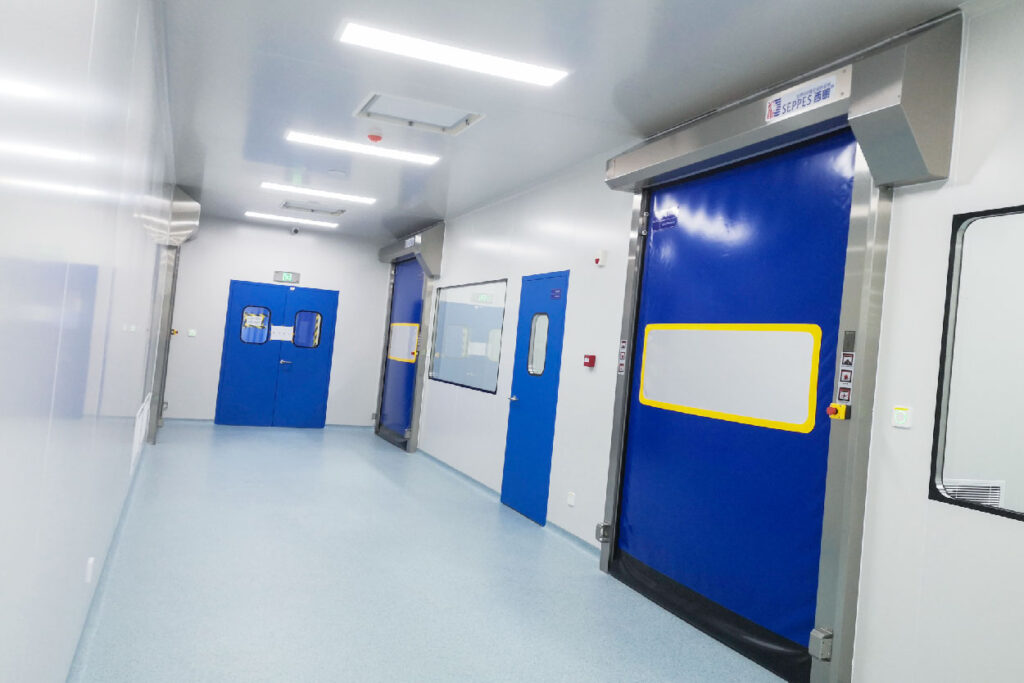
Procesamiento de Alimentos y Salas Blancas
Self-repairing high-speed roll-up doors play an essential role in food manufacturing and cleanroom environments by maintaining strict hygiene and environmental control. Their smooth, non-porous surfaces prevent dirt buildup and support sanitation compliance. Fast opening and closing reduce exposure time, minimizing the entry of dust, insects, and unwanted air.
Advanced models include antimicrobial materials, automated cleaning functions, and airlock compatibility—features that help prevent cross-contamination in food processing. These doors also support ISO cleanroom standards required in pharmaceutical and electronics facilities.
Thanks to their self-repairing mechanism, the doors recover quickly after impact, ensuring minimal downtime and helping these industries maintain productivity and operational compliance.
Instalaciones Automotrices y de Fabricación
In the automotive sector and manufacturing facilities, fast, reliable, and safe self-repairing high-speed doors are extremely important. These doors are designed to withstand high traffic and constant operation, and to save on maintenance costs, the doors self-reset. When damaged, the doors automatically reset, reducing maintenance costs and downtime. The doors’ rapid opening and closing speeds help streamline workflow by allowing fast movements of goods, parts, and equipment. Remaining closed during the rapid openings and closings ensures the doors are never a weak point in the indoor climate. This is especially critical in dust-free manufacturing environments or ones that require strict temperature control. Self-repairing high-speed doors are equipped with cutting-edge technology that makes workplaces safer and controls energy usage more efficiently. This is especially important to modern workplaces’ innovations in self-repairing high-speed manufacturing doors.
Personalización y Flexibilidad de Diseño
Opciones de Tamaño y Color
Customizable self-repairing high-speed doors can fit a wide range of sizes for different industrial and commercial uses. Whether a facility needs large warehouse openings or smaller specialized doorways, manufacturers provide tailored rapid-door solutions in almost any configuration.Standard and oversized sizes are easy to come by, allowing for seamless fitting in different facilities.
These doors can also be made in any color to match any art or branding that a space may possess. Many suppliers have a list of basic colors, such as red, blue, yellow, or green, but matching a color to company branding or for safety purposes is also very common.Using fully or partially transparent materials also helps let in more natural light and increases visibility. With this flexibility in size and color, manufacturers can make self-repairing high-speed doors both highly functional and visually appealing.
Integración con Sistemas de Control de Acceso
Self-repairing high-speed doors work with advanced control access systems to improve how a facility operates and to make it more secure. Modern doors work with RFID readers, biometric scanners, keypad entries, mobile app controls, and more to allow only specified access and to meet high security needs.
Moreover, these doors can connect to a building’s entire management system, allowing remote management and monitoring of control access points.The system features automatic entry and exit logs for easy security tracking, regulatory compliance, and a faster workflow. This ability to pair self-repairing high-speed doors with advanced access control systems is perfect for Industrial, commercial, and high-security systems. This integration improves security and also reduces footholds by enabling secure and fast access.
Ventajas Comparativas frente a las Puertas Rápidas Tradicionales
Autorreparación Automática vs. Intervención Manual
Automatic self-repairing high-speed doors offer superior convenience, accessibility, and energy efficiency but require higher upfront costs and maintenance, while manual intervention doors are cost-effective, reliable, and simpler to maintain but less accessible and convenient.
Tabular Summary:
| Automatic Doors | Manual Doors | |
| Costo | High upfront | Low upfront |
| Mantenimiento | Regular required | Mínimo |
| Comodidad | Alta | Moderada |
| Accessibility | Excellent | Limited |
| Energy Use | Eficiente | Variable |
| Seguridad | Advanced options | Básica |
| Fiabilidad | Complex | Simple |
| Hygiene | Touchless | Contact needed |
| Traffic | High-volume | Low-volume |
| Aesthetics | Modern | Las tradicionales |
Análisis de Costos y Retorno de la Inversión (ROI)
Self-repairing high-speed doors are an ideal solution for self-repairing high-speed doors with an emphasis on convenience. While these doors may cost more than other options on the market, the self-repairing features reduce the need for maintenance, saving money on future repairs. Ultimately, self-repairing doors are more cost-effective than traditional doors over a longer supply chain.
These high-speed doors also keep the temperature inside the building constant, saving money on utility bills as well. Keeping the energy cost down is a huge advantage in places where temperature control is important, like industrial buildings, warehouses, or cold food storage buildings.
Self-repairing high-speed doors are a smart investment as they can endure high traffic and challenging environments while maintaining efficient operation. Their use in the industrial sector with large resource-heavy machinery or high-volume logistical workflows is a huge benefit in productivity as well. When high-maintenance doors are avoided, the savings over time more than pay for the doors.
Considering cost-benefit analyses, these doors also foster enhanced operational efficiency and savings over time. The touchless tech, updated sensors, and other high-tech features add to the doors’ overall value offered to resource and temperature-controlled efficiency-focused businesses.
Conclusión: Tendencias Futuras y Valor de la Inversión
Papel en el Avance de la Automatización Industrial
Las puertas rápidas autorreparables están adquiriendo gran importancia para impulsar la automatización industrial. Estas puertas emplean nueva tecnología de autorreparación y están diseñadas para entornos con maquinaria pesada y altas exigencias de flujo de trabajo. Los ingenieros integran sensores avanzados y tecnología IoT para que las puertas funcionen de forma autónoma a través de sistemas de fábrica automatizados. Además, operan de manera fluida con líneas de transporte, brazos robóticos y otros equipos automatizados.
Los nuevos sistemas utilizan análisis de datos avanzados para evaluar y monitorizar las funciones de la puerta, identificando automáticamente fallos del sistema. Incluso pueden realizar pequeñas autorreparaciones con supervisión humana mínima o nula, dotando a la puerta de capacidad de automantenimiento. Esta capacidad reducirá los tiempos de inactividad, aumentará la productividad y disminuirá los costes de mantenimiento. Para mejorar la eficiencia energética, las puertas optimizarán el sistema térmico en las instalaciones automatizadas y equilibrarán la temperatura. Su rápido funcionamiento también ayudará a mantener los estándares de seguridad e higiene.
Gracias a su capacidad de conexión y adaptación, las puertas rápidas autorreparables contribuirán a mejorar la eficacia operativa en diversos ámbitos, garantizando un funcionamiento eficiente. Estas puertas optimizarán aún más los flujos de trabajo en una variedad de industrias.
Consideraciones para la Actualización a Puertas Rápidas Autorreparables
En el caso de las puertas rápidas autorreparables, analizo varios aspectos. Primero, analizo las operaciones realizadas en mi edificio, el tipo de tráfico, las condiciones meteorológicas y la frecuencia de uso de las puertas. Luego, analizo el ahorro en reparaciones y el tiempo de inactividad por mantenimiento, suponiendo que las puertas sigan funcionando sin necesidad de reparaciones. Evalúo la capacidad de las puertas para optimizar el consumo energético y su compatibilidad con otros sistemas de puertas/automatización que posea. Finalmente, analizo el tipo de construcción para valorar el ahorro global potencial, así como el valor de la mejora para mi edificio.
Preguntas Frecuentes (FAQs)
¿Qué es una puerta rápida de enrollar y en qué se diferencia de las puertas enrollables convencionales?
Las puertas rápidas enrollables están destinadas a aplicaciones industriales y utilizan una lona de alto rendimiento que se enrolla en un tambor para permitir ciclos rápidos de apertura y cierre. A diferencia de otras puertas enrollables, estos modelos priorizan la velocidad y la reducción del tiempo de inactividad. Suelen equiparse con un variador de frecuencia o un control de motor con inversor para un funcionamiento eficiente y suave. Estas puertas pueden adaptarse al tráfico peatonal y vehicular tanto en interiores como en exteriores.
¿Cómo se restauran a su posición original las puertas rápidas autorreparables tras una colisión accidental?
Las puertas rápidas autorreparables emplean un sistema de seguridad anticolisión con muescas de reenganche en la pista —situadas en la parte superior o a lo largo de los laterales— que permiten que el panel de la puerta se desacople y vuelva a entrar en la guía sin daños. Tras una colisión, la puerta regresa a su posición original de forma automática o con ayuda manual mínima. Este enfoque reduce el tiempo de inactividad y elimina la necesidad de realinear contrapesos o realizar reparaciones mayores.
¿Son adecuadas las puertas rápidas autorreparables para uso interior y exterior?
Sí, la mayoría de las puertas rápidas industriales y las puertas rápidas de lona admiten uso tanto en interiores como en exteriores. Los fabricantes las personalizan y modifican con características como juntas de estanqueidad, aislamiento y sistemas anticolisión. Gracias a opciones de control remoto, paneles personalizables y funciones de seguridad integradas, las puertas de lona de alto rendimiento y los sistemas tipo dynamicroll® se adaptan a diversos entornos y aplicaciones de puertas rápidas, garantizando un rendimiento consistente en operaciones interiores y exteriores.
¿Qué dispositivos de seguridad y características de sistema anti-colisión incluyen las puertas rápidas de enrollar autorreparables?
Las puertas rápidas enrollables autorreparables incorporan características de seguridad adicionales, como células fotoeléctricas y sensores de borde, alarmas audibles y sistemas anticolisión opcionales para detección de impactos. Para eventos de colisión, un sistema anticolisión y una muesca de reenganche en la pista correctamente posicionada en la parte superior o dentro de las guías permiten que la puerta se recupere sin daños. Los movimientos se controlan por seguridad mediante paneles de control con frecuencias e interbloqueos.
¿Pueden aislarse las puertas rápidas autorreparables o usarse como partición entre áreas de producción?
Es posible lograr control de temperatura y evitar el paso de partículas y flujos de aire mediante puertas rápidas autorreparables y puertas de lona de alto rendimiento, que pueden especificarse con capas aislantes o diseñarse como mamparas. Estos modelos de puertas de lona también proporcionan aislamiento al ecosistema, al tiempo que permiten un flujo de trabajo rápido en entornos que exigen movimiento de alto volumen y acceso operativo veloz.
¿Cómo afectan al rendimiento el panel de control, el inversor o la opción monofásica?
El panel de control, utilizado generalmente junto con un variador de frecuencia o inversor monofásico, controla la velocidad del motor, el arranque y parada suaves, y las rutinas de recuperación en los mecanismos autorreparables para prolongar la vida útil de la puerta, reducir el impacto de las sacudidas al abrir y cerrar rápidamente, y mejorar la capacidad para satisfacer requisitos específicos de diferentes modelos de puertas, adaptándose al volumen de tráfico y a las demandas energéticas de aplicaciones concretas, especialmente en el caso de lonas de alto rendimiento y puertas rápidas enrollables.
¿Qué mantenimiento requieren las puertas de enrollar de alto rendimiento de tejido y los sistemas BMP?
Los sistemas de puertas enrollables de lona de alto rendimiento, incluidos los sistemas BMP o dynamicroll®, cuentan con programas de mantenimiento que contemplan la inspección rutinaria de la lona rápida, las guías, las conexiones del panel de la puerta y los dispositivos de seguridad. Las inspecciones periódicas del sistema anticolisión, la muesca de reenganche de la pista, el equilibrio del contrapeso y los ajustes del panel de control permiten que los mecanismos autorreparables funcionen sin daños. Los programas de mantenimiento predictivo reducen la probabilidad de fallos del sistema y permiten que las puertas rápidas operen de forma fluida junto con sistemas de alta velocidad.
¿Cómo mejoran la usabilidad en entornos industriales las opciones de control remoto y la personalización?
Las puertas rápidas autorreparables ofrecen componentes modulares que permiten a los operadores modificarlas para adaptarse a procesos específicos. La integración de estas puertas con un sistema de gestión de edificios (BMP) y control de acceso con personalización remota proporciona un flujo de trabajo sin interrupciones. Estas puertas cumplen con los requisitos de seguridad y operativos en sitios industriales de alto uso mediante alertas sonoras y visuales para mejorar la seguridad, aislamiento para reducir el ruido y materiales de panel personalizados para limitar el desgaste. Los diseñadores también garantizan que las puertas operen con rapidez, ofreciendo ciclos de apertura/cierre veloces para soportar un alto flujo de tráfico.
Fuentes de Referencia
- IEEE Xplore: Arquitecturas de anillo de alta velocidad con autorreparación para futuras redes interoficinas – Analiza mecanismos de autorreparación en sistemas de alta velocidad.
- IOP Science: Análisis e investigación de fallos en operadores de puertas de ascensor de alta velocidad inteligentes basados en sistema MCU – Examina sistemas de puertas rápidas inteligentes y gestión de fallos.
- ScienceDirect: Preparación y estudio de rendimiento de un recubrimiento autorreparable con propiedades superhidrofóbicas – Explora materiales autorreparables aplicables a sistemas de alta velocidad.
- Taylor & Francis: La reparación de carrocerías de vehículos – Incluye perspectivas sobre sistemas de alto rendimiento y tecnologías de reparación.
- Virginia Tech VTechWorks: Comportamiento ante explosiones de puertas de acero metálico hueco – Investigación sobre puertas de alto uso en entornos industriales.