📞WhatsApp 86-18068436613

Comment les portes rapides rigides améliorent la sécurité

La sécurité est une considération importante pour les entrepôts, les usines, les centres de distribution, les installations de stationnement et autres bâtiments industriels. Les grandes ouvertures de portes peuvent devenir des points vulnérables lorsqu'elles sont fréquemment utilisées pour les véhicules, les chariots élévateurs, les employés et la manutention des matériaux.
Les portes rapides rigides offrent une solution en combinant une opération rapide avec une structure de porte plus robuste. Par rapport aux portes souples en tissu conventionnelles, les portes rapides rigides sont conçues avec des panneaux rigides ou des sections renforcées qui peuvent offrir une séparation physique plus importante et une meilleure résistance dans les environnements exigeants.
Mais comment les portes rapides rigides améliorent-elles la sécurité ?
La réponse implique plus que la simple résistance de la porte elle-même. L'ouverture et la fermeture rapides, le contrôle d'accès, la construction rigide, les systèmes de sécurité, la visibilité et l'intégration avec le contrôle d'accès peuvent tous contribuer à une entrée industrielle plus sécurisée.
Table des matières
BasculerQue sont les portes rapides rigides ?
Les portes rapides rigides sont des portes industrielles haute performance qui utilisent des panneaux rigides, des lames ou des sections renforcées au lieu d'un rideau souple en tissu.
Elles sont conçues pour les applications où la vitesse et la protection physique sont toutes deux importantes.
Une porte rapide rigide typique peut être utilisée à :
- Entrées d'usine
- Les ouvertures d'entrepôts
- Zones de chargement
- Centres de distribution
- Les installations de production
- Les installations de stationnement
- Les ouvertures industrielles extérieures
- Les passages logistiques à fort trafic
Contrairement à une porte industrielle conventionnelle qui peut rester ouverte pendant des périodes relativement longues, une porte rapide est conçue pour minimiser le temps pendant lequel l'ouverture reste exposée.
Cette combinaison d'opération rapide et de construction rigide rend les portes rapides rigides particulièrement utiles lorsque la sécurité est une partie importante du cahier des charges de la porte.
Comment les portes rapides rigides améliorent-elles la sécurité ?
Les portes rapides rigides peuvent améliorer la sécurité de plusieurs manières.
Ils peuvent aider à :
- Réduire le temps pendant lequel une entrée reste ouverte
- Créer une barrière physique plus solide
- Contrôler l'accès aux zones restreintes
- Réduire l'accès non autorisé des véhicules ou des piétons
- Améliorer la visibilité autour des entrées très fréquentées
- S'intégrer avec les capteurs et les systèmes de contrôle d'accès
- Offrir une meilleure protection pour les ouvertures extérieures
- Séparer les zones de production et de stockage
Cependant, une porte rapide ne doit pas être considérée comme un système de sécurité complet en soi. Son efficacité dépend de la construction de la porte, du système de contrôle, de la structure du bâtiment environnant, du contrôle d'accès, de l'installation et de l'environnement d'exploitation.
1. La fermeture rapide réduit le temps d'exposition d'une entrée
L'un des moyens les plus simples par lesquels les portes rapides peuvent améliorer la sécurité est la fermeture rapide.
Une entrée industrielle qui reste ouverte pendant une longue période donne aux personnes non autorisées plus d'opportunités d'entrer.
Cela peut être particulièrement important à :
- Les entrées d'entrepôts
- Quais de chargement
- Zones de production
- Les passages logistiques internes
- Les entrées extérieures d'usines
Une porte rapide peut se fermer automatiquement après le passage d'un véhicule ou d'une personne.
Cela crée un cycle d'exploitation simple :
Accès détecté → La porte s'ouvre → Le véhicule passe → La porte se ferme
En réduisant le temps pendant lequel l'ouverture reste ouverte, la porte peut aider à maintenir une meilleure séparation entre l'intérieur et l'extérieur d'une installation.
C'est l'une des raisons pour lesquelles les portes rapides destinées à renforcer la sécurité peuvent être envisagées pour les entrées industrielles à fort trafic.
2. La construction rigide offre une barrière physique plus solide
La construction physique de la porte est un autre facteur important.
Les portes rapides rigides utilisent des panneaux renforcés ou des sections rigides qui offrent une résistance structurelle supérieure à celle d'un simple rideau souple.
Cela peut être précieux pour les ouvertures extérieures où la porte doit offrir une barrière plus solide contre les accès non autorisés, les impacts accidentels, le vent et d'autres conditions environnementales.
Une porte rigide ne fonctionne pas simplement comme un rideau à mouvement rapide. Sa construction peut fournir une barrière plus substantielle lorsque la porte est entièrement fermée.
Pour les applications sensibles en matière de sécurité, la structure de la porte doit être évaluée conjointement avec le mur environnant, le cadre, les guides, le mécanisme de verrouillage et les autres composants du bâtiment.
3. Les portes rapides rigides pour les ouvertures extérieures
Les entrées extérieures nécessitent généralement une protection plus importante que les ouvertures intérieures.
Une porte installée à l'extérieur d'un bâtiment peut être exposée à :
- Des tentatives d'accès non autorisé
- Le vent et les intempéries
- Des impacts de véhicules
- La poussière et les débris
- Des différences de température
- Un trafic à haute fréquence
Les portes extérieures rigides à grande vitesse peuvent être envisagées pour ces applications car elles combinent une ouverture rapide avec une structure de porte plus robuste.
Lorsque la porte est fermée, le rideau rigide ou le système de panneaux peut fournir une séparation physique entre l'installation et l'environnement extérieur.
Lorsqu'un accès est requis, la porte peut s'ouvrir rapidement pour permettre le passage de véhicules autorisés, de chariots élévateurs ou de personnel.
4. Le contrôle d'accès pour les zones restreintes
La sécurité ne consiste pas uniquement à empêcher les personnes d'entrer dans un bâtiment. Elle consiste également à contrôler les mouvements entre différentes zones à l'intérieur de l'installation.
Les installations de fabrication et de logistique contiennent souvent des zones restreintes telles que :
- Le stockage de produits finis
- Les zones de stockage à haute valeur
- Les salles de production
- Les salles de serveurs ou d'équipements
- Les entrepôts à accès contrôlé
- Les zones de chargement et d'expédition
Une porte de sécurité à grande vitesse peut être intégrée à des systèmes de contrôle d'accès afin de restreindre les personnes autorisées à actionner la porte.
Les méthodes de contrôle possibles incluent :
- Les lecteurs de cartes
- Les claviers numériques
- Les télécommandes
- Les systèmes d'identification des véhicules
- Les systèmes de contrôle d'accès
- Les capteurs radar
- Des capteurs photoélectriques
- Les signaux de production automatisés
Cela permet à la porte de faire partie d'une stratégie d'accès plus large de l'installation.
5. L'intégration avec les systèmes de contrôle d'accès
Une porte rigide à grande vitesse peut fonctionner en synergie avec les systèmes de sécurité et de gestion technique du bâtiment existants.
Par exemple, un employé autorisé peut utiliser une carte d'accès pour demander l'entrée. Le système de contrôle d'accès vérifie l'autorisation et envoie un signal au contrôleur de la porte.
La porte s'ouvre ensuite, permettant à la personne ou au véhicule autorisé de passer.
Une fois le passage terminé, la porte se ferme automatiquement.
Ce type d'intégration peut réduire le besoin d'opération manuelle et contribuer à créer un point d'accès contrôlé.
Pour les installations disposant de plusieurs entrées, l'intégration du contrôle d'accès peut également faciliter la gestion des différents niveaux d'autorisation pour différentes zones.
6. Une opération plus rapide peut améliorer la sécurité du trafic
Le trafic à haute fréquence peut créer ses propres problèmes de sécurité.
Si les chariots élévateurs et les véhicules doivent attendre longtemps à une entrée, les opérateurs peuvent être tentés de laisser la porte ouverte.
Une fois qu'une porte industrielle est laissée ouverte, l'installation perd une partie de la séparation assurée par la porte.
Les portes industrielles à grande vitesse peuvent réduire ce problème en permettant aux véhicules de passer rapidement.
Par exemple :
Approche du chariot élévateur → Capteur détecte le chariot élévateur → La porte s'ouvre → Le chariot élévateur passe → La porte se ferme
Cela crée un cycle de circulation plus contrôlé.
L'objectif n'est pas simplement de faire fonctionner la porte plus rapidement. L'objectif est de rendre l'exploitation sécurisée pratique même lorsque l'entrée est utilisée fréquemment tout au long de la journée.

7. Une meilleure visibilité peut favoriser un accès plus sûr
Certaines configurations de portes rigides à grande vitesse peuvent inclure des panneaux de vision ou des sections transparentes.
Ces sections permettent aux opérateurs de voir l'activité de l'autre côté de l'ouverture avant que la porte ne soit entièrement ouverte.
Cela peut être utile dans les environnements industriels très fréquentés où les chariots élévateurs, les piétons et les véhicules automatisés partagent les mêmes voies de circulation.
Une meilleure visibilité peut contribuer à réduire les rencontres inattendues entre les véhicules et les piétons.
Cependant, la visibilité n'est qu'une partie d'une stratégie de sécurité complète. Des capteurs appropriés, des contrôles de circulation, des systèmes d'avertissement et des procédures de site doivent également être pris en compte.
8. La sûreté et la sécurité fonctionnent ensemble
La sûreté et la sécurité sont étroitement liées aux entrées industrielles.
Une porte sécurisée qui s'ouvre ou se ferme sans systèmes de sécurité appropriés pourrait créer des risques pour les travailleurs, les chariots élévateurs ou les équipements.
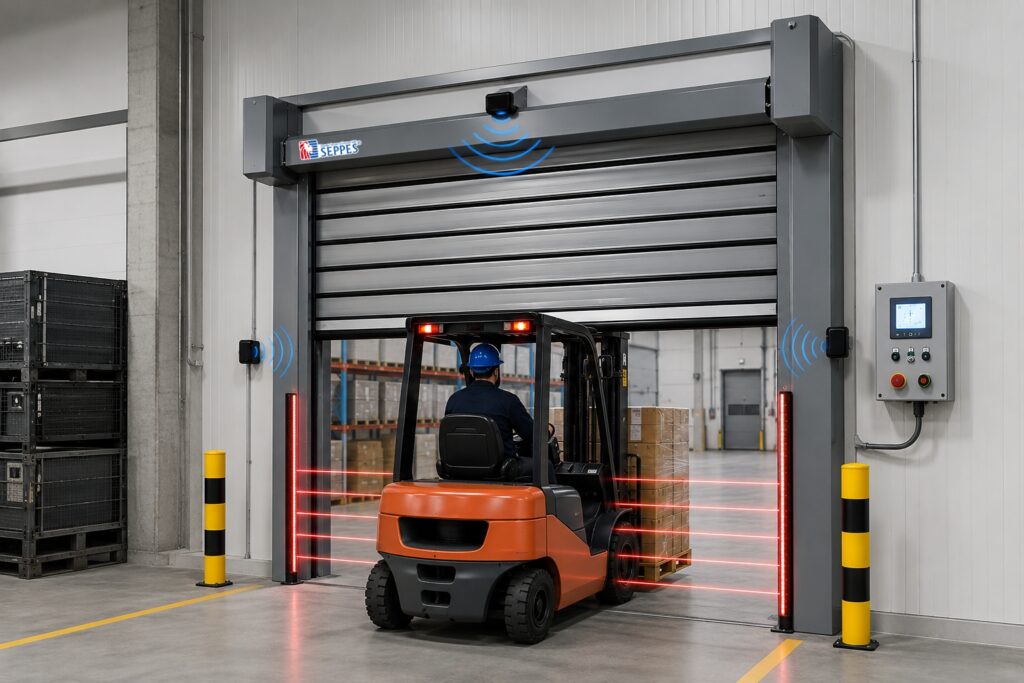
Pour cette raison, les portes de sécurité à grande vitesse peuvent être équipées de dispositifs de sécurité tels que :
- Des capteurs photoélectriques
- Des barrières immatérielles de sécurité
- Des bords de sécurité inférieurs
- La détection radar
- Des boutons d'arrêt d'urgence
- Des feux d'avertissement
- Des systèmes de réouverture automatique
Par exemple, si un obstacle est détecté pendant la fermeture de la porte, le système de commande peut arrêter ou inverser la porte selon la conception.
Cela contribue à protéger les personnes et les équipements tout en maintenant un accès contrôlé.
9. Les portes rapides à relevage vertical pour les applications de sécurité
Les portes basculantes à grande vitesse sont une autre option pour les installations industrielles qui nécessitent à la fois une ouverture rapide et un accès contrôlé.
Selon la conception, ces portes peuvent utiliser des panneaux rigides ou des sections renforcées qui offrent une barrière plus substantielle que les portes légères conventionnelles.
Elles peuvent être utilisées pour :
- Les entrées d'entrepôts
- Les zones de chargement des usines
- Centres de distribution
- Points d'accès des véhicules
- Itinéraires logistiques internes
Le type de porte approprié dépend du niveau de protection physique requis, des dimensions d'ouverture, de la fréquence de passage, de l'exposition au vent et de l'espace d'installation disponible.
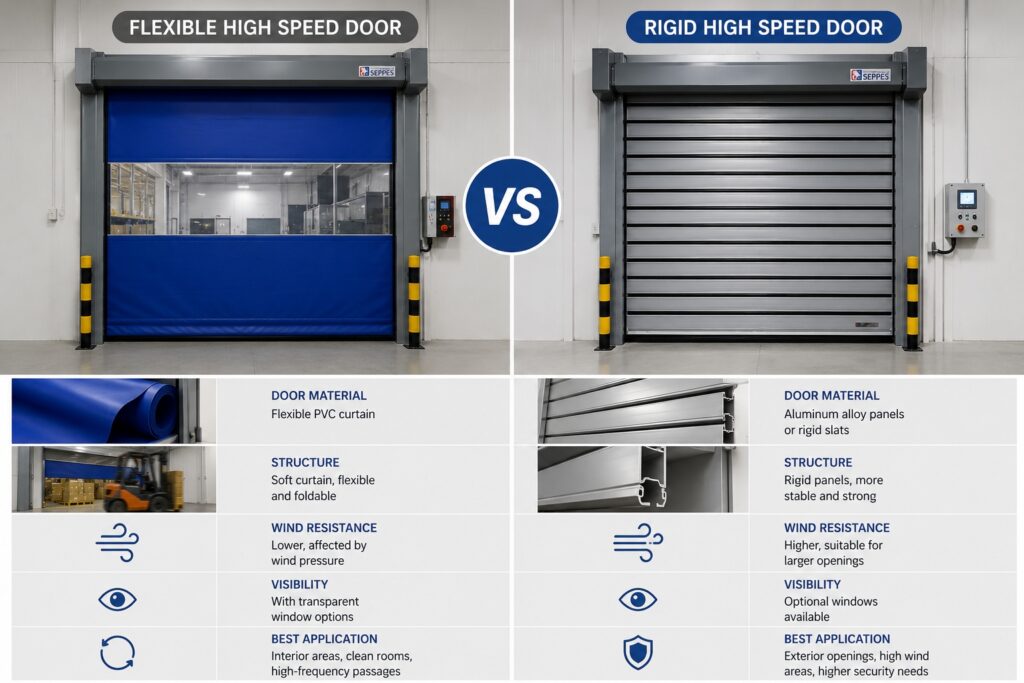
10. Les portes rapides rigides par rapport aux portes rapides souples
Les portes rapides rigides et souples remplissent des fonctions différentes.
Les portes souples utilisent généralement des rideaux en PVC ou en tissu et sont souvent choisies pour les applications où la rapidité d'ouverture, les cycles fréquents et la séparation efficace sont les priorités principales.
Les portes rapides rigides utilisent des panneaux renforcés ou des sections rigides et peuvent être privilégiées lorsqu'une protection structurelle supérieure est requise.
Une comparaison simplifiée se présente comme suit :
| Caractéristique | Porte rapide souple | Porte rapide rigide |
|---|---|---|
| Fonctionnement à haute vitesse | Oui | Oui |
| Trafic fréquent | Excellente | Excellente |
| Rigidité physique | Inférieur | Plus élevé |
| Applications extérieures | Selon le modèle | Bien adaptée aux applications appropriées |
| Priorité à la sécurité | Modéré | Barrière physique plus robuste |
| Résistance aux impacts | Dépend de la conception | Protection structurelle généralement supérieure |
| Options de visibilité | Disponibles sur certains modèles | Disponibles selon la conception |
| Contrôle d'accès | Disponible | Disponible |
Le bon choix dépend des exigences spécifiques de l'installation.
Une porte souple peut être plus appropriée pour la séparation interne de production, tandis qu'une porte rapide rigide peut être une meilleure option lorsque la protection physique et la sécurité extérieure sont des priorités plus élevées.
11. La protection des entrepôts et des stocks de grande valeur
Les entrepôts peuvent contenir des équipements coûteux, des composants, des matières premières et des produits finis.
Une entrée d'entrepôt fréquemment utilisée doit donc concilier accessibilité et sécurité.
Les portes rapides pour entrepôts peuvent contribuer à atteindre cet équilibre en permettant un passage efficace du trafic autorisé tout en réduisant le temps pendant lequel l'entrée reste ouverte.
Par exemple, un entrepôt peut utiliser une porte rapide rigide entre la zone de stockage et une zone de chargement externe.
En fonctionnement normal :
- Un véhicule autorisé s'approche.
- Le système de détection ou de contrôle d'accès identifie la demande.
- La porte s'ouvre rapidement.
- Le véhicule entre ou sort.
- La porte se ferme automatiquement.
Cela crée un cycle d'accès plus contrôlé sans ralentir significativement les opérations de l'entrepôt.
12. La combinaison de la sécurité avec l'efficacité opérationnelle
L'un des plus grands avantages des portes rapides rigides est que la sécurité ne doit pas nécessairement se faire au détriment de la productivité.
Une porte industrielle lourde traditionnelle peut offrir une barrière physique solide mais peut s'avérer peu pratique lorsque les véhicules doivent passer des centaines de fois par jour.
Une porte rapide rigide est conçue pour répondre à ces deux exigences.
Elle peut offrir :
- Un accès rapide
- Des cycles fréquents
- Une séparation physique
- Un fonctionnement automatisé
- Un accès contrôlé
- Un flux de trafic amélioré
Ceci est particulièrement utile pour les installations où la sécurité et l'efficacité logistique sont également importantes.
Que devez-vous prendre en compte lors du choix d'une porte de sécurité à grande vitesse ?
Choisir une porte rapide axée sur la sécurité nécessite plus que de simplement examiner la vitesse d'ouverture maximale.
Tenez compte des facteurs suivants.
Construction de la porte
Examinez le matériau, l'épaisseur, le renforcement, les guides, le cadre et la conception structurelle globale.
Pour les applications extérieures, la porte doit également être évaluée en fonction des conditions de vent et de météo.
Fréquence du trafic
Déterminez combien de fois la porte s'ouvrira et se fermera chaque jour.
Une porte utilisée des centaines de fois par jour nécessite une configuration différente d'une entrée utilisée occasionnellement.
Dimensions de l'ouverture
Tenez compte du plus grand chariot élévateur, camion, AGV ou autre véhicule devant passer.
L'ouverture doit offrir un dégagement suffisant sans créer d'espace inutile qui pourrait affecter la sécurité ou le contrôle environnemental.
Contrôle d'accès
Déterminez si la porte doit être connectée à :
- Contrôle par badge
- Les claviers numériques
- Les télécommandes
- Détection de véhicules
- Systèmes de gestion du bâtiment
- Systèmes de production automatisés
Systèmes de sécurité
Évaluez le besoin de radar, de capteurs photoélectriques, de barrières immatérielles, de bords sensibles, d'arrêts d'urgence et de systèmes d'avertissement.
Conditions environnementales
Pour les installations extérieures, tenez compte du vent, de la pluie, de la poussière, de la température et de la corrosion.
Pour les applications internes, tenez compte de la propreté, de l'humidité, des différences de température et des conditions de trafic.
Comment les portes rapides rigides SEPPES peuvent soutenir la sécurité industrielle
Les solutions de portes rapides SEPPES peuvent être configurées pour les environnements industriels où l'accès rapide, le fonctionnement fréquent, la séparation physique et le trafic contrôlé sont importants.
Pour les applications axées sur la sécurité, la solution globale peut être envisagée autour de la construction de la porte, du contrôle d'accès, des capteurs de sécurité, de la vitesse de fonctionnement, des dimensions d'ouverture et des exigences environnementales.
Cela est particulièrement pertinent pour les usines, les entrepôts, les installations logistiques et autres bâtiments industriels où les portes sont utilisées fréquemment mais où l'ouverture doit néanmoins rester contrôlée.
La meilleure solution de sécurité n'est pas nécessairement la porte la plus lourde ou la plus rapide. C'est le système qui correspond au trafic réel du site, aux exigences d'accès, à la structure du bâtiment et à l'environnement d'exploitation.
Questions Fréquemment Posées
Les portes rapides rigides sont-elles plus sécurisées que les portes rapides en tissu ?
Les portes rapides rigides offrent généralement une barrière physique plus solide car elles utilisent des sections de porte rigides ou renforcées. Cependant, la sécurité globale dépend également du cadre, des guides, du système de verrouillage, du contrôle d'accès, de l'installation et de la structure environnante du bâtiment.
Les portes rapides peuvent-elles empêcher les accès non autorisés ?
Elles peuvent contribuer à contrôler et à réduire les accès non autorisés lorsqu'elles sont combinées à un contrôle d'accès approprié et à des systèmes de fermeture automatique. Une porte rapide ne doit pas être considérée comme un système de sécurité autonome.
Une porte rapide rigide peut-elle être utilisée à l'extérieur ?
Oui. Certaines portes rapides rigides extérieures sont conçues pour les applications industrielles extérieures. La sélection doit tenir compte de la résistance au vent, de l'exposition aux intempéries, de la fréquence de trafic et du niveau de protection physique requis.
Les portes de sécurité à grande vitesse peuvent-elles fonctionner avec le contrôle d'accès ?
Oui. Les portes de sécurité rapides peuvent être intégrées à des lecteurs de cartes, des claviers, des télécommandes, des détecteurs de véhicules et d'autres systèmes de contrôle d'accès, selon le contrôleur de porte et les exigences du projet.
Les portes rapides à relevage vertical sont-elles adaptées aux entrepôts ?
Oui. Les portes rapides à relevage vertical peuvent être utilisées dans les entrepôts où le trafic fréquent de véhicules, l'opération rapide et l'accès contrôlé sont importants.
Les portes rapides rigides améliorent-elles la sécurité ?
Elles peuvent contribuer à une gestion plus sûre du trafic lorsqu'elles sont équipées de capteurs et de systèmes de sécurité appropriés. Les dispositifs de sécurité doivent être sélectionnés en fonction du schéma de trafic réel et des conditions du site.
Conclusion
Les portes rapides rigides peuvent améliorer la sécurité industrielle en combinant une opération rapide, une séparation physique, un accès contrôlé et des dispositifs de sécurité automatisés.
Au lieu de choisir entre sécurité et productivité, les fabricants et les exploitants d'entrepôts peuvent utiliser des systèmes de portes rapides pour soutenir les deux.
Les principaux avantages comprennent :
- Fermeture plus rapide après chaque passage
- Séparation physique plus solide
- Accès contrôlé aux zones restreintes
- Soutien à la sécurité des entrepôts et des usines
- Intégration avec les systèmes de contrôle d'accès
- Amélioration de la gestion du trafic
- Compatibilité avec les capteurs de sécurité
- Aptitude pour les applications extérieures exigeantes
Pour les installations qui nécessitent à la fois un accès fréquent et une barrière physique plus solide, les portes rapides rigides peuvent constituer un élément efficace d'une stratégie plus large de sécurité industrielle.
La configuration finale de la porte doit toujours être sélectionnée en fonction de la fréquence de trafic du site, des dimensions de l'ouverture, des conditions environnementales, des exigences de contrôle d'accès, des besoins de sécurité et du niveau de protection physique souhaité.