📞WhatsApp 86-18068436613

Comment choisir un capteur pour les portes à grande vitesse ?

Le choix du bon capteur est une étape importante dans la conception d’un système sûr et efficace. porte rapide système. Que vous installiez portes industrielles rapides dans une installation de fabrication, Portes rapides pour entrepôt dans un centre logistique, ou d’autres à isolation thermique pour les zones à forte circulation, le capteur doit correspondre à l’application, au schéma de circulation, à la vitesse de la porte et aux exigences de sécurité.
Modern les portes à haute performance sont conçues pour s’ouvrir et se fermer rapidement, contribuant ainsi à améliorer le flux de circulation, l’efficacité énergétique et la sécurité sur le lieu de travail. Cependant, la performance de la porte ne dépend pas uniquement de la porte elle-même, mais aussi de son efficacité à détecter les véhicules, les personnes et les obstacles.
Chez SEPPES, nous avons constaté que la sélection des capteurs est souvent négligée lors des premières étapes d’un projet de porte industrielle. En pratique, choisir le bon capteur peut avoir un impact significatif sur l’efficacité de la porte, la sécurité et l’expérience utilisateur globale.
Table des matières
BasculerPourquoi les portes à grande vitesse ont-elles besoin de capteurs ?
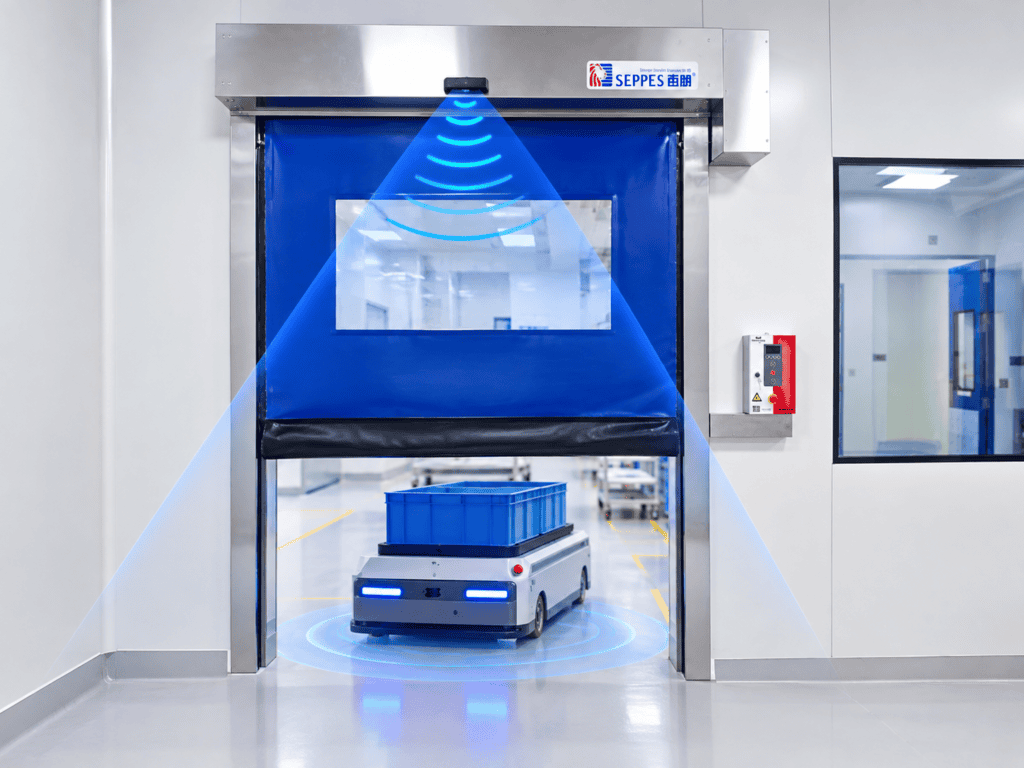
Les capteurs sont un élément essentiel d’un système de porte automatique à grande vitesse. Ils indiquent au contrôleur de la porte quand un véhicule ou une personne s’approche et peuvent également aider à détecter les obstacles pendant la fermeture de la porte.
Sans le bon capteur, une porte à grande vitesse peut s’ouvrir trop tard, rester ouverte inutilement ou ne pas offrir le niveau de sécurité requis.
Un capteur correctement sélectionné peut aider à :
- Activer automatiquement la porte lorsqu’un véhicule ou une personne s’approche
- Réduire les cycles d’ouverture et de fermeture inutiles de la porte
- Améliorer le flux de circulation dans les installations très fréquentées
- Réduire les échanges d’air et les pertes d’énergie potentielles
- Détecter les personnes, les chariots élévateurs ou d’autres obstacles
- Améliorer la fiabilité globale du système de porte
les portes de garage sectionnelles, portes industrielles rapides, la sélection des capteurs doit donc être considérée comme faisant partie de la conception globale de la porte plutôt que comme un simple accessoire ajouté après l’installation.
Quels types de capteurs sont utilisés pour les portes industrielles à grande vitesse ?
Différentes applications nécessitent différentes technologies de détection. Les options les plus courantes incluent les capteurs radar, les capteurs photodélectriques, les barrières immatérielles de sécurité et les boucles à induction.
1. Capteurs radar
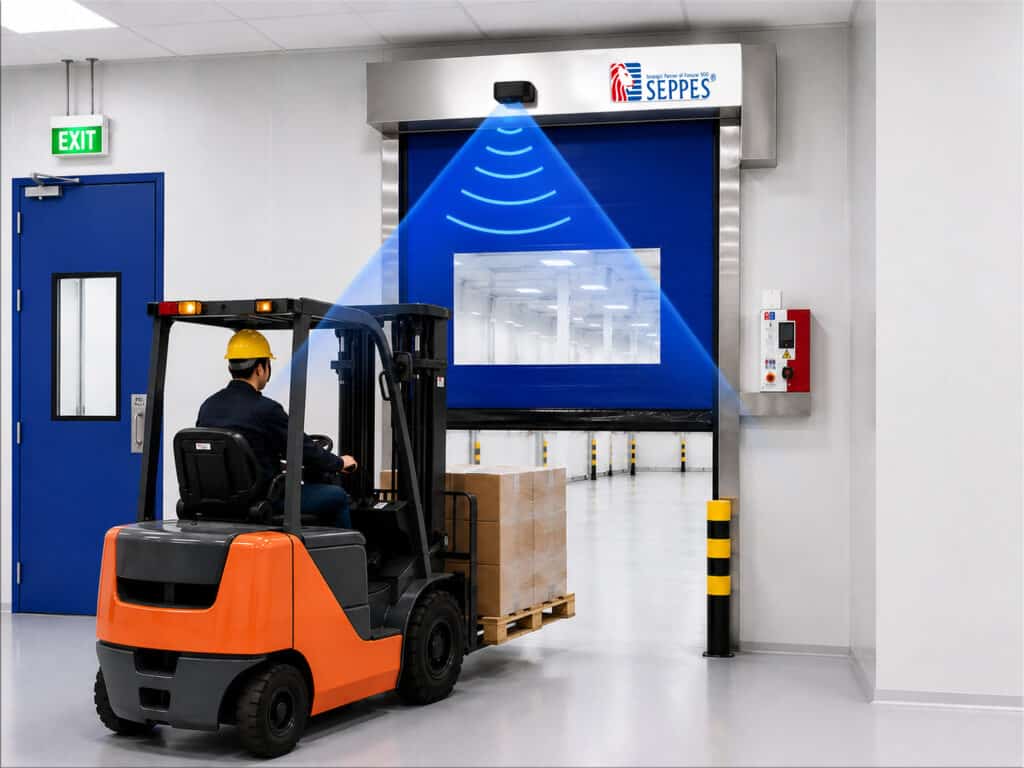
Les capteurs radar détectent les objets en mouvement à l’aide d’ondes électromagnétiques. Ils sont largement utilisés pour l’activation automatique des à isolation thermique, en particulier dans les zones où la circulation de chariots élévateurs et de véhicules est fréquente.
Un capteur radar peut détecter un chariot élévateur qui s’approche avant qu’il n’atteigne la porte, permettant à celle-ci de commencer à s’ouvrir automatiquement.
Les capteurs radar sont souvent adaptés pour :
- Entrepôts
- Centres de distribution
- Installations de fabrication
- Quais de chargement
- Les zones industrielles à forte circulation
Un avantage du radar est qu’il peut détecter le mouvement sans nécessiter de contact physique. Cela en fait une option pratique pour les applications où les véhicules s’approchent fréquemment de la porte.
Cependant, les capteurs radar sont principalement utilisés pour l’activation et la détection de mouvement, selon la conception spécifique du capteur. Ils ne doivent pas automatiquement être considérés comme un remplacement d’un dispositif de sécurité dédié.
2. Capteurs photodélectriques
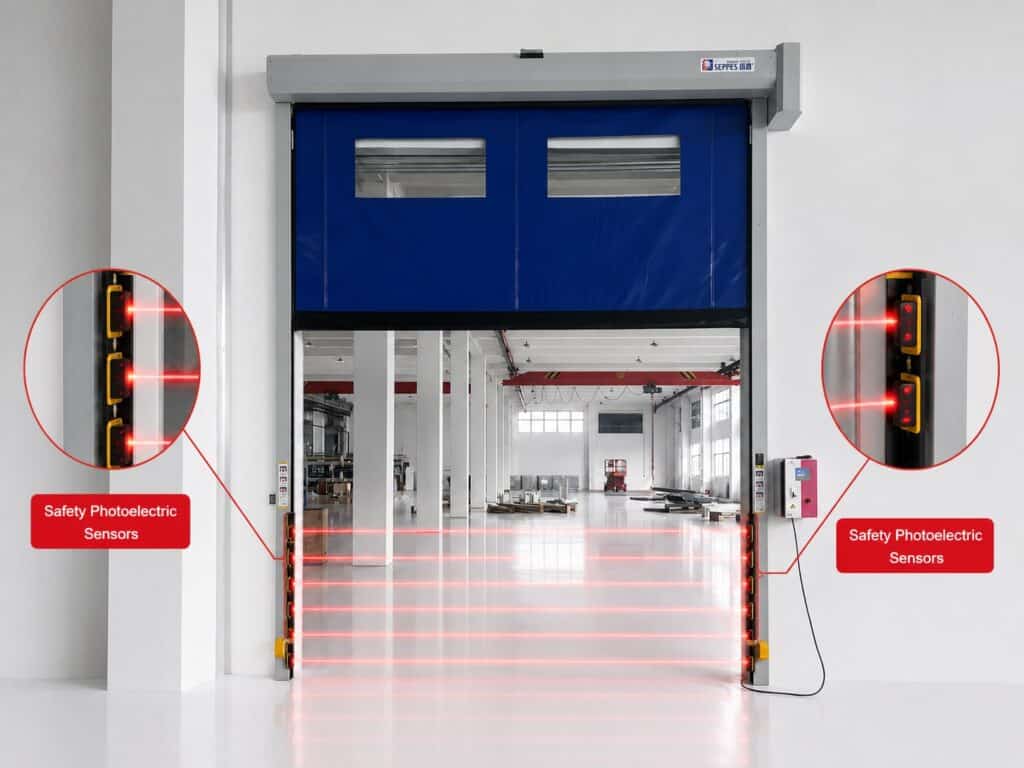
Les capteurs photodélectriques utilisent un faisceau lumineux, généralement infrarouge, pour détecter lorsqu’un objet interrompt le faisceau.
Selon la configuration, ils peuvent être utilisés pour l’activation de la porte, la détection de position ou des fonctions de sécurité.
Les capteurs photodélectriques sont couramment utilisés dans les systèmes de portes industrielles car ils sont relativement simples, fiables et faciles à intégrer aux contrôleurs de porte.
Lors de la sélection d’un capteur photodélectrique, tenez compte :
- Distance de détection
- Position d'installation
- Alignement du faisceau
- Conditions environnementales
- Temps de réponse requis
- Compatibilité avec le contrôleur de porte
3. Barrières immatérielles de sécurité
Les barrières immatérielles de sécurité créent un champ de détection à l'aide de multiples faisceaux infrarouges. Elles sont conçues pour détecter les personnes ou les objets pénétrant dans une zone protégée.
Pour une porte à grande vitesse, une barrière immatérielle peut être utilisée pour empêcher la porte de se fermer lorsqu'un obstacle est détecté dans la zone protégée.
Cela rend les barrières immatérielles de sécurité particulièrement utiles dans les endroits où les chariots élévateurs et les piétons partagent la même ouverture de porte.
Une distinction importante est que les capteurs d'activation et les capteurs de sécurité ont des fonctions différentes. Un capteur radar peut commander l'ouverture de la porte, tandis qu'une barrière immatérielle de sécurité peut contribuer à protéger la zone de fermeture.
4. Boucles à induction
Les boucles à induction sont installées dans ou sous le sol et détectent les véhicules grâce aux variations du champ électromagnétique.
Elles peuvent être utiles lorsqu'une porte est principalement utilisée par des véhicules plutôt que par des piétons.
Les applications typiques incluent :
- Entrées véhicules
- Quais de chargement
- Zones de stationnement
- Installations industrielles
- Points d'accès véhicules contrôlés
La principale considération est l'installation. Étant donné que la boucle est généralement installée dans le sol, des travaux de construction supplémentaires peuvent être nécessaires.
Comment choisir des capteurs pour les portes d’entrepôt à grande vitesse
Les portes de entrepôts à grande vitesse subissent souvent un trafic beaucoup plus important que les portes des installations commerciales de plus petite taille. Les chariots élévateurs, les transpalettes, les véhicules de livraison et les piétons peuvent traverser la même ouverture tout au long de la journée.
Pour cette raison, la sélection des capteurs doit commencer par l'analyse du schéma de circulation.
Circulation de chariots élévateurs
Si les chariots élévateurs sont les principaux utilisateurs de la porte, un capteur radar peut être une option appropriée pour l'activation automatique.
Le capteur doit détecter l'approche du chariot élévateur suffisamment tôt pour que la porte s'ouvre avant que le véhicule n'atteigne l'ouverture.
La portée de détection doit également être adaptée à la vitesse d'ouverture de la porte. Une porte très rapide ne nécessite pas nécessairement une portée de détection extrêmement longue si le capteur et le contrôleur sont correctement configurés.
Circulation mixte de chariots élévateurs et de piétons
Lorsque les chariots élévateurs et les piétons utilisent la même ouverture, le système peut nécessiter plus d'un type de capteur.
Par exemple :
Capteur radar → activation automatique de la porte
Capteur de sécurité ou barrière immatérielle → protection contre les obstacles
L'utilisation de différents capteurs pour différentes fonctions peut offrir une solution plus complète que de tenter d'utiliser un seul capteur pour toutes les fonctions.
Entrepôts à forte circulation
Dans un centre logistique très actif, les cycles de porte inutiles peuvent réduire l'efficacité et augmenter l'usure mécanique.
Le capteur doit donc être configuré pour détecter le trafic prévu tout en minimisant les activations intempestives.
La portée de détection, la sensibilité, la position de montage et le temps d'ouverture de la porte doivent tous être pris en compte lors de l'installation.
Capteurs radar ou photodélectriques pour les portes à grande vitesse
Il n'existe pas de capteur unique qui soit le meilleur pour chaque application.
| Caractéristique | Capteur radar | Capteur photovoltaïque |
|---|---|---|
| Détection de véhicules en mouvement | Excellente | Bon |
| Activation automatique de la porte | Excellente | Bon |
| Détection sans contact | Oui | Oui |
| Applications à fort trafic | Excellente | Bon |
| Applications de sécurité | Dépend de la conception | Courant |
| Installation | Généralement simple | Nécessite un alignement précis |
| Principal avantage | Détecte le mouvement d'approche | Interruption fiable du faisceau |
Pour l'activation automatique, le radar est souvent un choix solide pour les environnements industriels très fréquentés.
Pour la protection de sécurité, les capteurs photovoltaïques ou les barrières immatérielles de sécurité peuvent être plus appropriés.
Dans de nombreuses applications, l'utilisation de capteurs d'activation et de sécurité offre une meilleure solution globale.
Comment les capteurs affectent les portes industrielles à haute performance
Le capteur n'est pas simplement un accessoire. Il peut affecter directement l'efficacité avec laquelle une porte industrielle haute performance fonctionne.
Une porte haute performance peut être capable de s'ouvrir et de se fermer très rapidement, mais si le capteur détecte l'approche d'un chariot élévateur trop tard, l'avantage pratique de la vitesse d'ouverture élevée de la porte est réduit.
De même, si un capteur a une portée de détection excessive ou un mauvais positionnement, la porte peut s'ouvrir inutilement et rester ouverte plus longtemps que nécessaire.
les portes de garage sectionnelles, les portes à haute performance, le capteur, le contrôleur, le moteur et la porte elle-même doivent donc fonctionner comme un système intégré.
Chez SEPPES, nous considérons généralement la porte et le capteur comme faisant partie de la même application plutôt que de sélectionner chaque composant indépendamment. La configuration appropriée dépend de l'utilisation réelle de l'ouverture de porte.
Qu’en est-il des portes de garage à grande vitesse ?
Les exigences en matière de capteurs pour les portes de garage à grande vitesse peuvent être différentes de celles des applications industrielles et d'entrepôt.
Un garage peut avoir une fréquence de trafic plus faible, des tailles de véhicules différentes et des conditions d'installation différentes. Le capteur doit donc être sélectionné en fonction de l'utilisation réelle de la porte.
Par exemple, un garage réservé aux véhicules peut utiliser un capteur de détection de véhicules, tandis qu'une zone où circulent à la fois des véhicules et des piétons peut nécessiter une protection de sécurité supplémentaire.
Le principe important reste le même : choisir le capteur en fonction de l'application plutôt que de simplement sélectionner le capteur le plus avancé ou le plus coûteux disponible.
5 facteurs à considérer lors du choix d’un capteur pour porte à grande vitesse
Avant de sélectionner un capteur, tenez compte de ces cinq facteurs.
1. Vitesse de la porte
Plus la porte fonctionne rapidement, plus le synchronisme entre la détection et le mouvement de la porte devient important.
Le capteur doit détecter le trafic concerné suffisamment tôt pour permettre à la porte de s’ouvrir en douceur, sans délais inutiles.
2. Type de circulation
Demandez qui ou quoi passera à travers la porte :
- Chariots élévateurs
- Camions
- Voitures
- Transpalettes
- Piétons
- Trafic mixte
Différents types de trafic peuvent nécessiter différentes technologies de détection.
3. Distance de détection
Tenez compte de la distance à laquelle l’objet doit être détecté.
Un chariot élévateur approchant d’une porte d’entrepôt peut devoir être détecté plusieurs mètres avant d’atteindre l’ouverture, tandis qu’un capteur de sécurité peut n’avoir besoin de protéger que la zone immédiate de la porte.
La distance de détection correcte dépend de la vitesse de la porte, de la vitesse du trafic et de l’agencement du site.
4. Environnement d’installation
L’environnement peut avoir un effet significatif sur les performances du capteur.
Tenez compte de :
- Poussière
- Eau
- Humidité
- Température
- Exposition extérieure
- Lumière directe du soleil
- Conditions de lavage
- Vibrations
Par exemple, un capteur utilisé dans une installation industrielle poussiéreuse peut avoir des exigences différentes de celles d’un capteur installé dans un entrepôt propre.
5. Exigences de sécurité
La considération la plus importante est peut-être la sécurité.
Ne supposez pas qu’un capteur d’activation automatique remplit la même fonction qu’un capteur de sécurité.
Le système complet peut nécessiter des dispositifs distincts pour :
- L’activation de la porte
- La détection d’obstacles
- L’arrêt d’urgence
- La surveillance de la position de la porte
La configuration finale du capteur doit être sélectionnée en fonction de la conception de la porte, du système de commande, de l’application et des exigences de sécurité applicables.
Combien de capteurs une porte à grande vitesse nécessite-t-elle ?
Il n’existe pas de nombre universel.
Une application simple peut ne nécessiter qu’un seul capteur d’activation, tandis qu’une porte industrielle très fréquentée peut utiliser plusieurs capteurs pour l’activation et la sécurité.
Par exemple, une configuration typique pourrait inclure :
Capteur d’approche → ouvre la porte
Capteur de sécurité → détecte les obstacles
Bord de sécurité inférieur → offre une protection supplémentaire
La configuration exacte dépend du type de porte, du système de commande, du schéma de trafic et des exigences de sécurité applicables.
Un exemple pratique : choix des capteurs pour un entrepôt
Considérez un entrepôt logistique où des chariots élévateurs traversent une porte à grande vitesse tout au long de la journée.
La première question n’est pas simplement “ Quel capteur devrions-nous acheter ? ”
Au lieu de cela, tenez compte de :
- À quelle vitesse les chariots élévateurs se déplacent-ils ?
- À quelle distance de la porte la détection doit-elle commencer ?
- Des piétons utilisent-ils la même ouverture ?
- La porte est-elle installée à l’intérieur ou à l’extérieur ?
- La zone est-elle poussiéreuse ou humide ?
- Quels dispositifs de sécurité sont requis ?
- Comment le capteur communique-t-il avec le contrôleur de la porte ?
Pour ce type d’application, SEPPES évaluerait généralement l’environnement d’exploitation complet avant de recommander une configuration de capteurs.
Un capteur radar peut convenir pour détecter l’approche des chariots élévateurs et activer la porte, tandis qu’un dispositif de sécurité distinct peut être utilisé pour protéger la porte pendant la fermeture.
Cette approche basée sur l’application est généralement plus fiable que la sélection d’un capteur uniquement en fonction de sa portée de détection ou de son prix.
Erreurs courantes dans la sélection des capteurs
Choisir un capteur sans tenir compte de la circulation
Un capteur qui fonctionne bien pour les piétons peut ne pas être idéal pour les chariots élévateurs ou les camions.
Utiliser un capteur d’activation comme capteur de sécurité
Ces deux fonctions ne sont pas nécessairement identiques. Vérifiez toujours la fonction prévue et les spécifications du capteur.
Ignorer l’environnement
La poussière, l’humidité, la température, la lumière du soleil et les vibrations peuvent affecter les performances du capteur.
Installer le capteur dans la mauvaise position
Même un capteur de haute qualité peut avoir de mauvaises performances si sa zone de détection ne correspond pas au chemin de trafic réel.
Ne pas vérifier la compatibilité avec le contrôleur
Avant d’acheter un capteur, vérifiez son type de sortie, sa tension de fonctionnement, sa méthode de connexion et sa compatibilité avec le contrôleur de la porte.
Questions Fréquemment Posées
Quel est le meilleur capteur pour une porte à grande vitesse ?
Il n’existe pas de meilleur capteur unique pour chaque application. Les capteurs radar conviennent souvent à l’activation automatique dans les zones à fort trafic, tandis que les capteurs photodélectriques et les rideaux de lumière de sécurité sont couramment utilisés pour les fonctions de sécurité.
Les capteurs radar peuvent-ils être utilisés sur les portes industrielles à grande vitesse ?
Oui. Les capteurs radar sont couramment utilisés pour l’activation automatique des portes industrielles à grande vitesse, en particulier lorsque des chariots élévateurs et d’autres véhicules s’approchent fréquemment de la porte.
Quel capteur est le meilleur pour les portes d’entrepôt ?
Pour les applications d’entrepôt avec un trafic fréquent de chariots élévateurs, le radar peut être une option appropriée pour l’activation automatique. Un capteur de sécurité distinct peut également être requis en fonction de la conception de la porte et de l’application.
Un seul capteur peut-il détecter les chariots élévateurs et les piétons ?
Certains capteurs peuvent détecter les deux, mais les performances de détection dépendent de la technologie spécifique du capteur, de la configuration et de l’environnement. Les applications à trafic mixte doivent être évaluées avec soin.
Les portes industrielles à grande vitesse nécessitent-elles des capteurs de sécurité ?
Les dispositifs de sécurité requis dépendent de la conception de la porte, de l’application et des exigences de sécurité applicables. Les portes industrielles à grande vitesse doivent être conçues avec un système de sécurité approprié plutôt que de s’appuyer uniquement sur un capteur d’activation.
Comment un capteur de porte à grande vitesse doit-il être positionné ?
La position dépend du type de capteur et de la zone de détection souhaitée. Un capteur d’activation doit généralement détecter le trafic approchant suffisamment tôt pour ouvrir la porte, tandis qu’un capteur de sécurité est positionné pour protéger la porte ou la zone de fermeture.
Conclusion
Le choix d'un capteur pour une porte à grande vitesse ne se résume pas à trouver un dispositif qui détecte le mouvement. La solution adaptée dépend de la vitesse de la porte, du type de trafic, de la distance de détection, de l'environnement d'installation et des exigences de sécurité.
les portes de garage sectionnelles, portes industrielles rapides et Portes rapides pour entrepôt, les capteurs radar constituent souvent un choix pratique pour l'activation automatique, en particulier dans les zones à fort trafic de chariots élévateurs. Les capteurs photodélectriques et les barrières immatérielles de sécurité peuvent offrir une protection supplémentaire lorsque la détection d'obstacles est requise.
Que vous sélectionniez des capteurs pour à isolation thermique, les portes à haute performance, ou d'autres applications de portes industrielles, la meilleure approche consiste à concevoir le système de capteurs et la porte ensemble.
Chez SEPPES, notre approche consiste à examiner l'application complète avant de recommander une configuration de capteurs. Si vous planifiez un projet de porte à grande vitesse, vous pouvez partager avec notre équipe les dimensions de la porte, la vitesse de fonctionnement, le type de trafic, l'environnement d'installation et la zone de détection requise.
L'objectif est simple : choisir le capteur adapté à la manière dont votre porte sera réellement utilisée.