📞WhatsApp 86-18068436613

High Speed Industrial Doors: Types, Benefits & Buying Guide

High speed industrial doors are designed for factory, warehouse and logistics openings that require frequent traffic, fast opening cycles and better environmental control.
For most indoor production and warehouse areas, flexible high speed roll up doors are a practical option. Facilities that need stronger security or exterior protection can consider rigid high speed doors, while cold rooms normally require insulated high speed freezer doors.
The right choice depends on the opening size, traffic frequency, operating environment, required opening method and safety requirements.
Table of Contents
ToggleWhat Are High Speed Industrial Doors?
High speed industrial doors are automatic industrial doors engineered to open and close much faster than conventional sectional doors or rolling shutters.
They are commonly installed between production areas, warehouses, logistics passages, clean areas and temperature-controlled rooms.
Unlike traditional doors that may remain open for longer periods, high speed doors shorten the time an opening is exposed. This helps control airflow, dust, temperature changes and unnecessary energy loss.
They can also be integrated with factory automation systems and different activation devices, making them suitable for areas with frequent forklift, vehicle or personnel movement.
Common Types of High Speed Industrial Doors
Different operating environments require different door structures.
| Door Type | Typical Application | Main Advantage |
|---|---|---|
| High speed fabric door | Factory and indoor passage | Fast operation and flexible curtain |
| High speed roll up door | Warehouse and logistics area | Compact structure and frequent cycling |
| Self-repairing high speed door | Forklift and busy traffic area | Curtain can automatically reset after certain impacts |
| Rigid high speed door | Exterior opening and secure area | Higher strength and security |
| High speed freezer door | Cold room and freezer | Temperature control and insulation |
| Cleanroom high speed door | Pharmaceutical and clean production | Better environmental separation |
High Speed Fabric Doors
High speed fabric doors use a flexible PVC curtain and are widely used inside factories and warehouses.
Their lightweight curtain allows frequent opening and closing while occupying relatively little installation space.
They are commonly used for production lines, workshops, logistics corridors and areas where people or forklifts pass frequently.
High Speed Roll Up Doors
High speed roll up doors roll the curtain around the upper shaft when opening.
The compact operating structure makes them suitable for industrial openings where overhead space is limited.
They are particularly common in warehouses, factories, loading areas and internal production passages.
Rapid roll doors are another commonly used term for this type of fast-operating industrial door.
Self-Repairing High Speed Doors
In busy logistics environments, accidental contact between a forklift and a flexible door curtain can occur.
Self repairing high speed doors are designed so that the curtain can disengage from the side guide under certain impacts and automatically return to the guide during the next operating cycle.
This design can reduce downtime and maintenance caused by minor accidental collisions.
They are especially useful in logistics centers, warehouses and production areas with frequent forklift traffic.
Rigid High Speed Doors
Rigid high speed doors normally use aluminum or other rigid door panels instead of flexible PVC fabric.
They combine faster operation with higher structural strength.
These doors are suitable for exterior factory entrances, parking facilities and industrial openings where security, wind resistance and frequent operation are all important.
High Speed Freezer Doors
Cold storage facilities have different requirements from standard factories.
High speed freezer doors are designed to reduce the time that cold-room openings remain exposed.
Fast closing helps reduce warm-air infiltration, temperature fluctuations and unnecessary refrigeration load.
Depending on the operating temperature, cold-storage doors may also require insulation, heated components or additional sealing systems.
Typical High Speed Door Specification Checklist
Before requesting a quotation, buyers should confirm the main technical requirements.
| Parameter | Information to Confirm |
| Door opening size | Width × height |
| Application | Indoor, exterior, warehouse, cleanroom or cold storage |
| Traffic type | Personnel, forklift, AGV or vehicle |
| Curtain or panel | Flexible PVC or rigid structure |
| Opening method | Push button, radar, pull cord, remote control or other sensor |
| Safety requirement | Safety edge, photocell or other protection according to configuration |
| Operating frequency | Approximate cycles per day |
| Environmental requirement | Dust, temperature, pressure difference, wind or hygiene |
| Automation | PLC, AGV, conveyor or access-control integration if required |
Providing these details allows a high speed door manufacturer to select the correct structure instead of quoting only according to door dimensions.
Where Are High Speed Doors Used?
High speed doors are used across many industrial environments.
Warehouses and Distribution Centers
High speed warehouse doors are commonly installed between storage areas, picking zones and shipping areas.
Fast opening helps forklifts pass efficiently while automatic closing reduces the time different warehouse zones remain connected.
This is particularly useful in facilities with continuous material movement.
Manufacturing Plants
Factories use high speed industrial doors to separate production areas while maintaining smooth material flow.
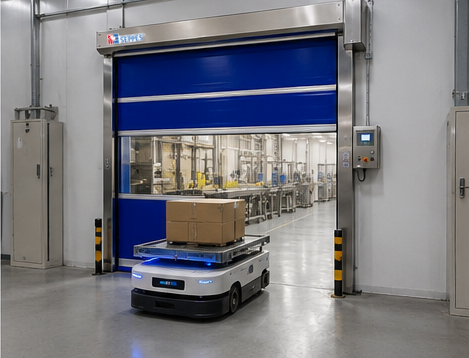
Doors can be activated by radar, pull cord, push button, remote control or signals from automated equipment.
For automated factories, they can also work with conveyors, AGVs, robots or PLC control systems.
Food Processing Facilities
Food production facilities often need to separate different processing or hygiene zones.
High speed doors reduce unnecessary exposure between areas and can help control dust, insects and airflow.
For washdown or hygiene-sensitive environments, stainless steel components may also be considered.
Cold Storage and Freezers
Fast doors are especially useful between normal-temperature areas and cold rooms.
Because each opening can allow warm air into the refrigerated area, reducing opening time can help maintain more stable temperatures.
High speed freezer doors are therefore commonly used in food warehouses, cold-chain logistics centers and refrigerated production facilities.
Automotive and Service Areas
Fast-opening doors are also used in automotive factories, service bays and parking facilities.
They allow vehicles to enter quickly while helping separate indoor and outdoor environments.
Main Benefits of High Speed Industrial Doors
Faster Material Flow
The most obvious advantage is faster access.
When forklifts or employees pass through an opening repeatedly, reducing every opening and closing cycle can improve traffic efficiency.
Reduced Energy Loss
Traditional doors may remain open unnecessarily.
Fast automatic closing reduces the period during which conditioned indoor air can escape or outside air can enter.
This is particularly valuable for air-conditioned production areas and cold-storage facilities.
Better Environmental Separation
High speed doors can help separate dust, airflow, temperature and different production zones.
They are commonly used where one facility contains multiple operating environments.
Suitable for Frequent Operation
Industrial passages may operate hundreds of times per day.
High speed doors are designed for repeated cycles and are therefore more suitable for busy passages than doors intended mainly for occasional access.
Multiple Opening Methods
Industrial users can select the activation method according to traffic.
Common options include:
Push button
Remote control
Radar sensor
Pull cord
Vehicle loop detector
Access control
Automatic equipment signal
Choosing the right activation method can further improve traffic efficiency.
High Speed Doors vs Traditional Industrial Doors
High speed doors and conventional industrial doors are designed for different priorities.
| Requirement | High Speed Door | Conventional Sectional / Rolling Door |
| Opening speed | Faster | Slower |
| Frequent operation | Very suitable | Depends on configuration |
| Environmental separation | Strong advantage | Moderate |
| Security | Depends on door type | Often stronger |
| Interior traffic | Excellent | Suitable |
| Exterior security | Rigid models recommended | Commonly suitable |
| Automation integration | Highly suitable | Possible |
If the main requirement is frequent material movement, high speed doors are usually more efficient.
If the door is opened only several times per day and security is the primary concern, a sectional door or traditional rolling shutter may be sufficient.
How to Choose a High Speed Door Manufacturer
Price should not be the only factor when comparing suppliers.
A qualified high speed door manufacturer should first understand the actual application and operating conditions.
Before placing an order, confirm:
Whether the door is suitable for the actual opening size.
Whether it is designed for indoor or exterior use.
Whether the operating frequency matches the door design.
Which safety devices are included.
Which opening methods are available.
Whether customized dimensions and materials are supported.
Whether automation interfaces are available.
What installation documentation will be supplied.
Which spare parts are available after delivery.
What warranty and technical support are provided.
For international projects, buyers should also confirm packaging, electrical standards, installation guidance and export documentation before shipment.

What Information Is Needed for a High Speed Door Quotation?
For an accurate quotation, prepare the following information:
Door width and height
Quantity
Installation location
Indoor or exterior application
Required opening method
Vehicle or personnel traffic
Operating temperature
Required material
Safety requirements
Automation or PLC requirements
Photos or videos of the opening can also help the supplier evaluate installation conditions.
FAQ
What is the difference between high speed doors and rapid roll doors?
Rapid roll doors are generally a type of high speed door. The term usually refers to flexible doors with a curtain that rolls around an upper shaft and opens quickly.
Are high speed doors suitable for warehouses?
Yes. High speed warehouse doors are commonly used in logistics corridors, forklift passages, picking areas and entrances that operate frequently.
Can high speed doors be used outdoors?
Yes, but the door structure must be suitable for exterior conditions. For openings exposed to wind or requiring better security, rigid high speed doors may be more appropriate than lightweight fabric doors.
What are self repairing high speed doors?
Self repairing high speed doors use a flexible curtain system designed to recover from certain minor impacts. After the curtain leaves the guide, it can return to the track during subsequent operation, depending on the door design.
Can high speed doors work with forklifts or AGVs?
Yes. High speed industrial doors can use radar, loop detectors, sensors or control signals to coordinate with forklifts, AGVs and automated production equipment.
Are high speed doors suitable for cold storage?
Yes. High speed freezer doors are specifically designed for refrigerated and frozen environments where fast opening and closing help reduce temperature exchange.
How do I choose the right high speed industrial door?
Start with the application rather than only the door size. Confirm traffic frequency, indoor or outdoor installation, temperature, security requirements, opening method, safety devices and automation requirements before selecting the door type.
Conclusion
High speed industrial doors are best suited to facilities where frequent traffic, fast access and environmental separation are important.
Flexible high speed roll up doors and high speed fabric doors are practical for factories and warehouses, self repairing models are useful in high-traffic forklift areas, while rigid and freezer doors solve more demanding exterior and temperature-control applications.
Before purchasing, provide the supplier with accurate opening dimensions, operating conditions, traffic type and control requirements. This allows the manufacturer to select a door based on the actual application rather than simply supplying a standard product.